Iraqi election fingerprint scam

cartoon

I’m glad the elections in Iraq went well — even though more than 30 people died as a result of anti-democracy attacks. Hopefully the high voter turnout is a sign that things will soon improve for the beleaguered nation.

But am I the only one who sees the requirement to provide a fingerprint as proof of voting as a way to happily scam people into providing personal information so the authorities can build a thorough database on all of its citizens?

The argument is that if you have nothing to hide, then why would you resist? Clearly those who subscribe to this point of view have read neither Kafka nor Orwell.

Bad rollovers

While we’re on the topic of bad Web typography, let me take a moment to complain about bad link styles.

It is possible, using CSS, to design a wide variety of typographical effects when it comes to Web links and what happens when the cursor rolls over them (referred to as a "rollover effect"). You can make it so the color changes, the font changes, underlines appear or disappear, bold is applied, or Italics, or a change in font face, among other things. While there may be some design advantages to using these effect (usability, aesthetics, etc.) please use good judgement when doing so. In particular, I advise strongly against making rollover effects that in any way changes the size or weight of the text characters.

For example, a color change, underline, or background color change does not affect the size or weight. Font changes, or the addition or removal of bold or Italics, do.

The problem with character size changes on rollovers is that when the effect occurs, everything under those characters is displaced, which can be a jarring and unattractive visual effect. It is annoying and amateurish, so don’t do it.

Below is an example from www.reservaycata.com, taken from a page where they discuss the Iberian wine appellation of Valdepeñas. Note how rolling over a link causes the link text to switch to Italics, which causes an ugly ripple effect on the rest of the text. I gladly recommend wine from Valdepeñas, but this rollover effect is awful.

bad effect

Ugly Web Typography

Recently, I’ve noticed a lot of articles on the Web using an unusual format when putting things in quotation marks. The quotation opens with a pair of a grave accents (like this: “) and closes with a pair of apostrophes (like this: ”). Below is an example from Bloomberg.com, with the quotation marks put in red (my modification). (Full article here, if you’re interested.)
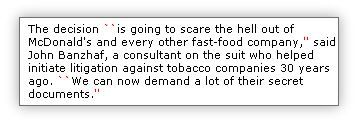
odd quotation marks

I only find this on Web sites for large publications, such as Bloomberg. Smaller publications and blogs use the expected standard quotation marks.

But why? Why would these publications use this more cumbersome punctuation over regular quotation marks?

I’m speculating, but I suspect is has something to do with needing to clearly define the beginning and end of a quotation — not for the sake of the reader, but for some other, more technical reason.

In printed typography, the beginning and end of quotations are marked with curly quotes (also known as smart quotes). Curly quotes curl towards the text “like this”. However, Web browsers don’t easily handle curly quotes. For example, if you cut and paste directly from MS Word into a Web form or editor, it will either convert curly quotes (or apostrophes) into straight quotes "like this", or it will generate a character identification error like this .

Or it might work correctly. It depends on several factors, such as the form or editor being used, the Web browser being used, and the declarations at the beginning of the HTML file. You can understand why large publications would want to go around this issue by creating a new standard.

But again, why? Why do they need to have their quotations machine-understandable? Or am I going in a completely wrong direction with this inquiry?

I wonder about this because typography makes up a small but significant part of my life — or at least my work — and because I am naturally curious about these things. This accent-and-apostrphe  solution probably works, but it is ugly to the eye. So what pressing behind-the-scenes technical need do these publishers have that trumps typography?

Fluffy

Oh my, wasn’t that a fluffy snowfall we had yesterday? No, really, I don’t remember the last time I saw such a powdery day. Big fluffy snowflakes like feathers, slowly swirling and falling. Beautiful.

fluffy!